
Snow Clearing Service
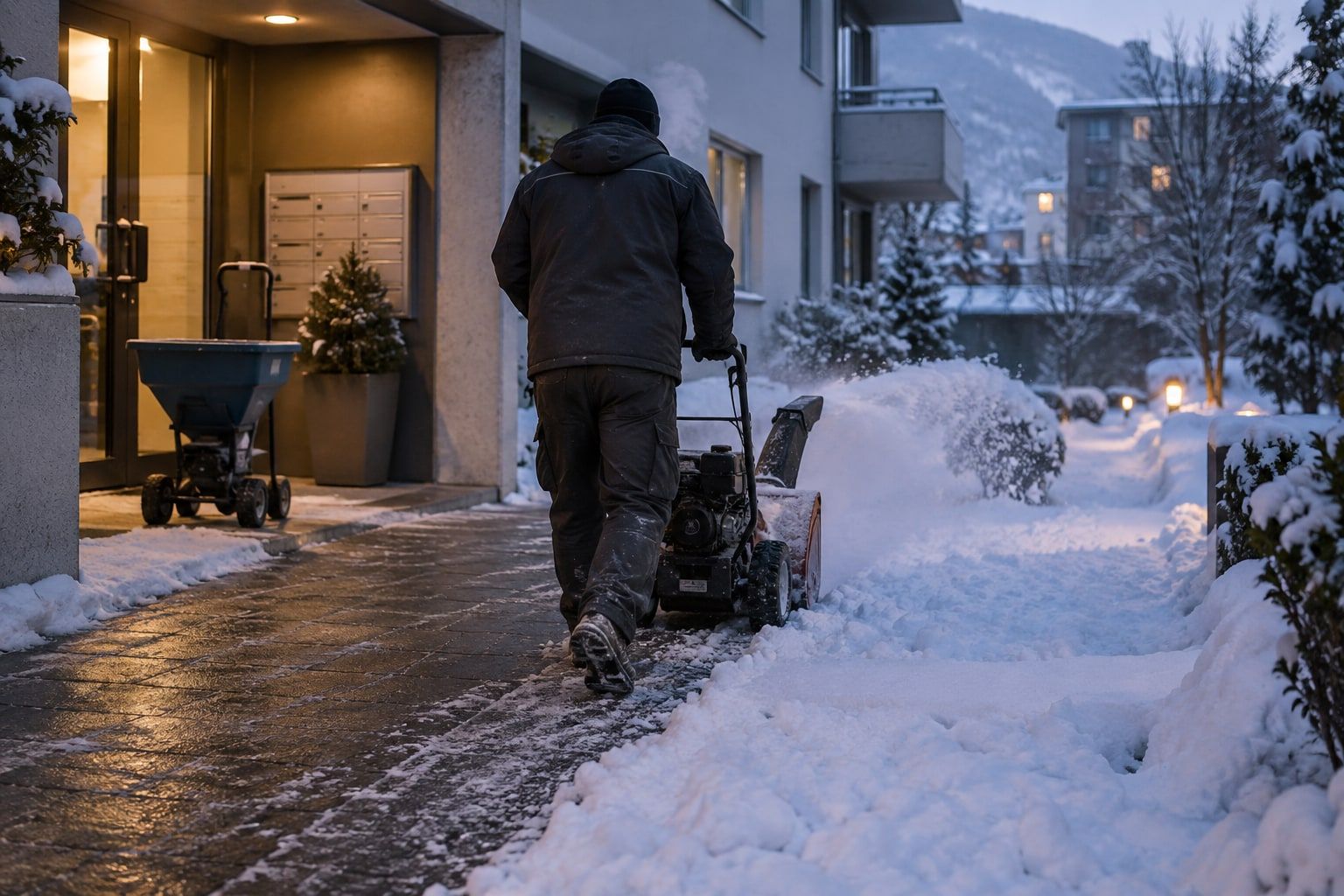
Snow clearing and gritting for private driveways and entrances, exactly where the municipality's own service stops. A fixed call-out plan, logged for your managing agent.
Most foreign owners assume that once the municipality’s plough has been down the street, winter is dealt with. It is not. Swiss municipalities clear public roads and, in many cases, public pavements. The stretch from the property boundary to the front door, the private driveway, the visitor parking, the last few metres to the letterbox, is the owner’s job. This is not a grey area. It is a legal duty of care, and it is enforced: if someone slips there, liability sits with the property owner, not with the municipality that ploughed the road outside.
This surprises owners who manage a Swiss property from abroad more than almost anything else about Hauswartung, property maintenance, in this country. Several municipalities in this area, including Schübelbach, which Siebnen partly belongs to, spell out their own priorities in public: main and public-transport roads first, then residential streets and car parks, then remaining footpaths, with steeper roads gritted first. What is conspicuously absent from every such list is private ground. Wangen SZ went further and adopted a formal winter service concept in January 2026 that explicitly requires adjoining owners to remove their own snow piles and forbids pushing them onto public ground. The message from every municipality office is consistent: the private side of the boundary is not theirs to clear.
What we do, in order
Before the season starts, we agree with the managing agent exactly which surfaces are covered: entrances, private driveways, visitor parking, paths to letterboxes and cellar doors. When snow falls, we check these surfaces before tenants’ usual start of the working day and clear before the first pedestrian is out. During sustained snowfall, further checks follow through the day. Gritting is applied sparingly and only where needed, with the same restraint several municipalities in this area apply to their own residential streets: Gossau ZH, for instance, does not salt residential streets, pavements or car parks except during heavy icing, to protect green areas and drainage. Cleared snow stays within the property boundary, stored where it blocks nobody, never on public ground and never into the drainage system, since Rüti, Wald ZH and Bäretswil each forbid that expressly. Every visit produces a written record with date and time, which a managing agent can point to as evidence of a duty of care that was actually met, not assumed.
Where this typically goes wrong
The most common mistake is assuming the municipality has it covered. That is only true for the public road. Uster grits residential streets from six percent gradient upward, but on private roads winter clearing there is explicitly voluntary, and liability stays with the owner regardless. A second, less obvious factor is altitude. Wald ZH reaches 1243 metres above sea level and Bäretswil 1077 metres, well above the valley floor around Hinwil or Siebnen. Snow arrives earlier there, stays longer, and needs tighter check intervals than a property closer to the lake. An owner who plans winter cover for a hillside property the same way as for one on the flat gets an unpleasant surprise in January. A third mistake is over-salting out of caution. Several municipalities avoid it on their own residential streets specifically to protect paving and planting, and the same restraint applies on private ground unless ice risk is acute.
Who this is for
This is aimed first at property management companies and managing agents, Bewirtschafter, who need a continuous, documented answer to the duty of care question for the owners’ meeting rather than a grey area that becomes a dispute after an accident. It also suits owners’ associations and private owners of multi-unit buildings who cannot shovel the entrance themselves, and commercial properties with customer parking, where a cleared driveway at seven in the morning shapes the first impression of the day.
Process and quote
The quote is based on a short walk-through of the surfaces to be cleared and the site’s location, since altitude and exposure change the workload significantly. From that we set a fixed price for the season with clearly defined standby cover, the Offerte. Contracts usually run from November to March and should be signed before the first snowfall, not after.
Service area
We cover winter clearing in the March SZ district and the Höfe area from Siebnen, in the Zurich Oberland, also from Siebnen, with particular attention to higher-lying municipalities such as Wald ZH and Bäretswil, where winter starts earlier, and in the Wil SG area from our location in Wil.
In these municipalities
These places have their own page covering what applies locally, with a source for every statement.
- Snow Clearing Service Siebnen
- Snow Clearing Service Wangen SZ
- Snow Clearing Service Reichenburg
- Snow Clearing Service Hinwil
- Snow Clearing Service Rüti
- Snow Clearing Service Gossau ZH
- Snow Clearing Service Bäretswil
- Snow Clearing Service Wald ZH
- Snow Clearing Service Uster
- Snow Clearing Service Uzwil
- Snow Clearing Service Oberuzwil
- Snow Clearing Service Kirchberg SG
Frequently asked questions
Doesn't the municipality already clear our street?
The municipality clears public roads, usually in priority order: main and public-transport routes first, then residential streets, footpaths last. Private driveways, entrances and visitor parking on the property itself remain the owner's responsibility in every municipality in this area.
Who is liable if someone slips outside the entrance?
The pavement and road in front of a building are usually the municipality's job. The stretch from the property boundary to the front door is not. That is the owner's duty of care, and it is enforced. This is exactly the area we cover under a fixed standby plan.
How quickly can you be on site after overnight snowfall?
We check every property under contract before tenants' usual start of the working day and clear ahead of the first pedestrian if needed. During sustained snowfall, further checks follow through the day so entrances do not snow back over.
Where does the cleared snow go?
Snow is stored within the property boundary, at a point that does not block anyone, and never pushed onto public ground or into the drainage system. Several municipalities in this area forbid that expressly and do check for it.
Do you grit with salt or with grit?
It depends on the surface and on local municipal practice. Several municipalities in the area do not salt residential streets and pavements at all except during heavy icing, to protect green areas and drainage. We apply the same restraint on private ground unless there is an acute slip risk.
Is this a full-season contract or a per-visit call-out?
We recommend a fixed contract for the winter season with standby cover, because it is budgetable for a managing agent and keeps the duty of care covered continuously. Individual call-outs are also possible by arrangement.
Enquire about Snow Clearing Service
This is about your job: Snow Clearing Service. Briefly tell us what you need and we will respond personally.