
Garden Maintenance
Standing garden and grounds maintenance for rental properties, run on a fixed schedule with logged visits for your managing agent.
A landlord based in London or Munich rarely finds out that a hedge has grown over a neighbour’s boundary from a phone call. They find out when a tenant complains, when the managing agent flags it at the annual meeting, or when they visit the property once a year and the lawn is knee high. In Switzerland, garden and grounds care for a rented property, the Liegenschaft, is not something a distant owner can check on casually. Someone local has to be responsible for it, on a schedule, with a record of what was actually done.
That is the gap this service closes. Property maintenance in Switzerland normally runs as a standing contract with a fixed visit schedule rather than a call placed whenever the grass looks long. For an owner who is not in the country, or a facility manager responsible for several buildings from an office abroad, that structure matters more than it would for someone who drives past the property every week. We look after garden and grounds maintenance for multi-unit buildings, owners’ associations and individual properties with grounds across March SZ, the Zürcher Oberland and the Wil SG area, as a recurring contract with a clear rhythm agreed in advance.
What we do, in order
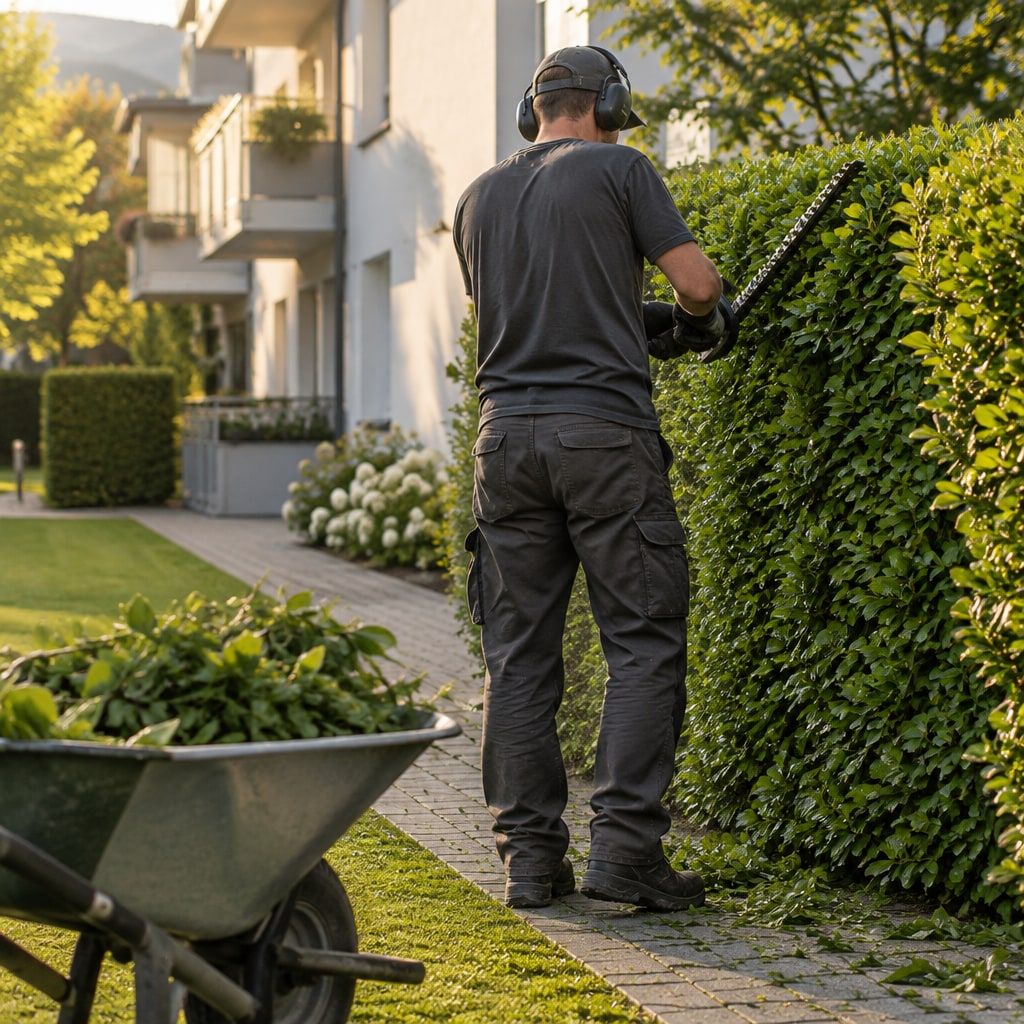
Care follows the growing season rather than the calendar month. From April to October, mowing is the main task, on a rhythm dictated by area and weather, usually every one to two weeks. Beds, paths and driveways are kept clear of weeds so gravel and paving joints do not disappear under growth. Hedges and shrubs get seasonal shaping during the growing months so that sightlines at driveways and house numbers stay clear, which matters for delivery drivers and visitors who do not know the property. Any hard cutback, the kind that visibly shortens a hedge, is scheduled for late winter or early autumn, outside the bird nesting season. Autumn brings leaf clearance, so paths do not become slippery and lawns do not suffocate under a wet layer. During hot, dry spells in midsummer we adjust cutting height and frequency rather than mowing to a fixed calendar, so the turf is not stressed further by heat. Mowing itself is timed to avoid the quiet hours that most municipalities in the area set by regulation, in particular Sundays. Every visit is logged briefly, so the managing agent can see exactly what was done and when, without having to be on site.
Where this typically goes wrong
Most complaints about grounds care are not about bad work. They are about gaps. A contractor who comes one month and is forgotten the next leaves a visible hole in the schedule, and a lawn shows it fastest. Timing of hedge work is underestimated just as often. Cutting a hedge back hard in early summer does not just leave it bare until autumn, it can also put the owner at odds with neighbours and with nesting season protections that apply generally across Switzerland. A third point that gets missed at the offer stage is what counts as extra work. Storm damage or heavy snow load on shrubs is not automatically covered by a standard contract, and it is far better to agree that in writing before the season starts than to argue about an invoice afterwards. Clippings left lying on the lawn instead of being collected is another common shortcut. It causes brown patches and thatch build-up quickly, especially in courtyards that see heavy foot traffic.
Who this is for
This service is aimed first at property management companies and managing agents, the Bewirtschafter, who look after several properties and want one dependable, documented contact instead of coordinating a different gardener for each address. It suits owners’ associations that want a clear, budgetable line item to present at the annual meeting. It also suits private owners of multi-unit buildings with grounds, particularly those who live abroad and cannot take care of the garden themselves or coordinate it from a distance.
Process and quote
The first step is a short site visit, where we assess area, planting and access. From that we put together a maintenance plan with a fixed rhythm and a fixed price per season or per year, the Offerte, which a managing agent can enter directly into the service charge statement or the annual budget presented to owners. Contracts usually start at the beginning of the growing season in spring, but can be set up at any point in the year.
Service area
We look after properties in the March SZ district and the Höfe area from Siebnen, in the Zurich Oberland, also from Siebnen, covering Wetzikon, Rüti, Wald ZH and Bäretswil, and in the Wil SG area from our location in Wil.
Frequently asked questions
How often do you come by in summer?
Usually every one to two weeks from April to October, depending on lawn area and growth. We agree the exact rhythm with the managing agent before the contract starts and write it into the maintenance plan.
When do you cut hedges without upsetting tenants?
Any hard cutback that visibly shortens a hedge happens in late winter or early autumn, outside the bird nesting season. Seasonal shaping during the growing months is scheduled with the managing agent so it does not clash with a letting period.
Does the managing agent get proof the work was done?
Yes. Every visit produces a short written record with the date, the work carried out and anything unusual we noticed. Owners abroad and their managing agent can rely on that instead of a phone update.
What happens if a storm brings down branches or leaves?
For work outside the fixed cycle we agree a call-out visit and give the managing agent a rough cost estimate first, so nothing appears unexplained on the invoice.
Do you also plant beds and pots?
Planting, reseeding and replacing dead shrubs are part of the service if this is agreed in the maintenance plan. We suggest low-maintenance planting that suits the site rather than anything decorative but demanding.
From what size of property does a standing contract make sense?
Even a single multi-unit building with grounds benefits, because a fixed rhythm works out cheaper and more predictable than ad hoc call-outs. Larger plots get a staged plan with several visits a month.
Enquire about Garden Maintenance
This is about your job: Garden Maintenance. Briefly tell us what you need and we will respond personally.