
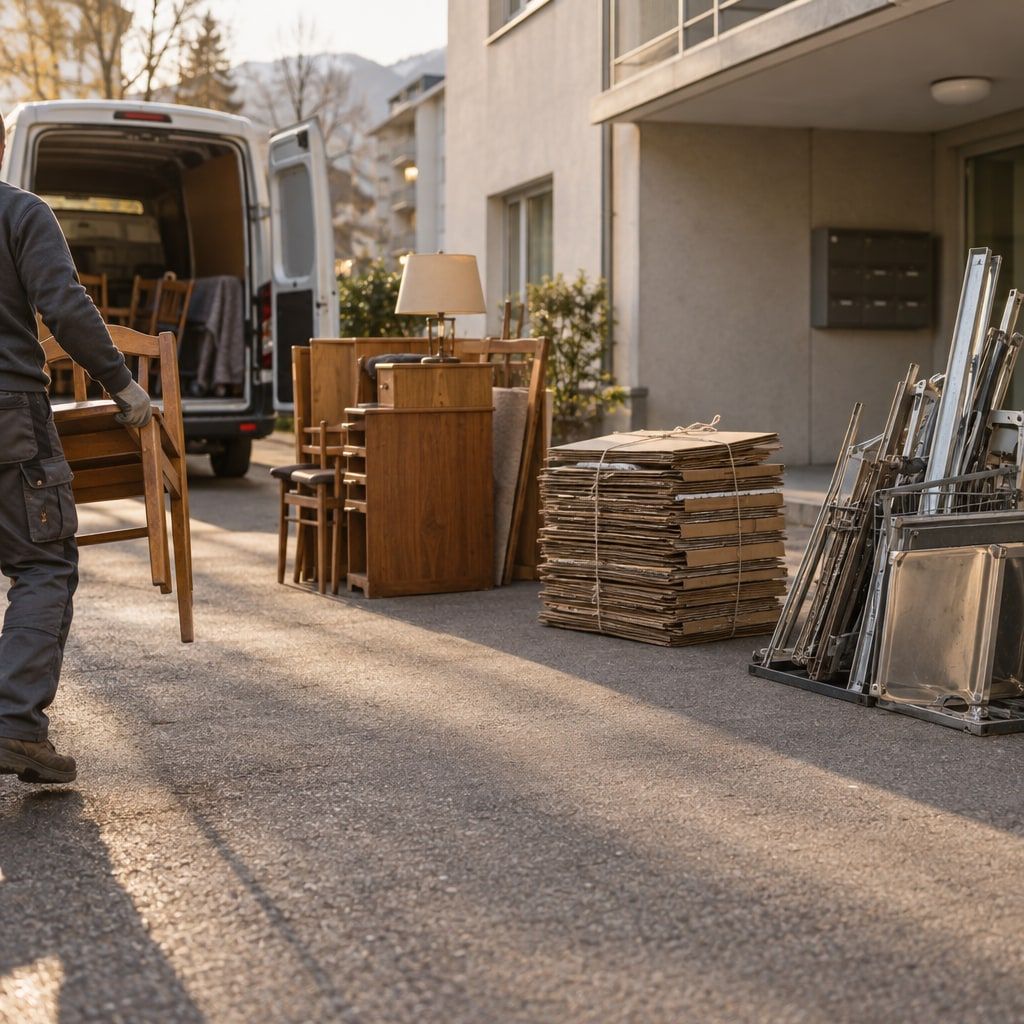
House Clearance and Disposal
House clearance with sorted disposal: whatever can be sold or recycled is kept separate, the rest disposed of properly, priced by the work involved.
A clearance rarely lands at a convenient time. After a death in the family, before a move into a care home, or when a managing agent finds household items left behind after a tenant change and nobody comes back for them: the time pressure is usually high, and the flat still has to be handed over broom-clean at the end.
For anyone new to Switzerland, a clearance also touches rules that are easy to get wrong from outside. Swiss waste disposal is strictly regulated at municipal level, general refuse bags usually need a paid, municipality-specific tag or sticker, and electrical goods, batteries, paint and other hazardous items cannot simply go in with the household rubbish. Clearing a household is more than carrying things out the door. What can be sold or passed on has to be separated from what belongs in refuse, recycling, or the hazardous-waste collection point, and that sorting is what determines the disposal cost more than anything else.
How a clearance runs
It starts with a site visit, where we assess the volume and mix of belongings, furniture, appliances, textiles, paper, bulky items. From that comes a sort into four categories: resale or handover to a second-hand shop, recycling through metal, cardboard and electronic-waste collection points, chargeable refuse and bulky waste, and hazardous waste such as paint or chemicals through the municipality’s designated collection point. Appliances such as fridges, washing machines or old televisions go back through the standard take-back scheme, which is free of charge for private customers and noticeably reduces the amount going to refuse. On the clearance day itself, we remove the household items according to this sorting, leave the rooms broom-clean, and hand them over directly to the managing agent if required.
For larger properties, a whole detached house with cellar and attic for example, sorting often takes longer than the actual removal. Cellars and attics collect items over years that are hard to place, from old skis to boxes from a move years earlier. A first pass through the contents with family members, before larger volumes are disposed of wholesale, is usually worth the time.
Where disposal costs rise unnecessarily
The biggest cost driver in a clearance is a missing sort. If everything is declared as general refuse or bulky waste, you pay for material that could actually be disposed of free through metal or electronic-waste recycling, or that could still be sold through a second-hand shop. Hazardous waste is underestimated just as often: leftover paint, solvents or old batteries do not belong in a normal refuse bag, they go to the municipality’s collection point, otherwise the collection can be refused outright. Garden waste from a garden or balcony also belongs in the separate green-waste collection rather than the refuse bag, something that is frequently missed when clearing a detached house. We sort on site rather than throwing everything into one container at the end.
What happens to usable furniture
Before anything goes to waste, we check what can still be sold or passed on. Furniture, crockery or appliances in good condition go to a second-hand shop or an organisation that redistributes household goods. That not only lowers the disposal cost, it also means usable items get a second life rather than simply disappearing. With an inherited household spanning several decades of furniture, this sorting is particularly worthwhile, since the value of individual pieces can vary a great deal.
Who this is for
We carry out clearances for families and heirs after a bereavement, for private individuals moving into a care home or out of a rental flat, and for managing agents and property managers when household items are left behind after a tenant change. For larger volumes, such as a whole detached house, we work with established partner firms, so the clearance still meets its deadline despite the time pressure.
Quote and booking
The quote (Offerte) is based on a site visit and already includes the estimated disposal costs, so nothing comes as a surprise afterwards. We note briefly which items are earmarked for resale or handover and which go straight to disposal, so family members or the managing agent can follow what happened. For urgent dates, such as a managing agent’s deadline after a tenant change, we prioritise the site visit accordingly and confirm the clearance date at short notice.
Where we work
We carry out clearances from Siebnen across March SZ and the Höfe, also from Siebnen across the Zürcher Oberland, from Lachen and Freienbach to Wetzikon, Rüti and Uster, and from our location in Wil across the Wil SG area. With a detached house and grounds, common across the Zürcher Oberland, the job usually includes clearing the garage, garden shed or outbuilding too, not just the living space. If a handover clean for the rental deposit (Mietkaution) follows the clearance, the move-out cleaning service can be booked straight after.
Frequently asked questions
How much does a house clearance cost?
That depends on the volume, the mix of household items, and the time available. Furniture and appliances that can be sold or passed on reduce disposal costs, while bulky waste and electronic scrap increase them. After a site visit you receive a fixed-price quote that already includes disposal costs, so there is no surprise at the end.
What happens to furniture that is still usable?
We sort usable furniture and appliances out for resale or handover to a second-hand shop (Brockenhaus) rather than disposing of them directly. That reduces the amount going through refuse or bulky-waste collection, and with it the disposal costs.
How quickly can a clearance happen, for example after a bereavement?
For urgent cases such as a bereavement or a short-notice tenancy end, we can usually arrange a site visit and then the clearance date within a few days. For larger volumes we bring in a partner firm if needed, so a managing agent's deadline is still met.
Is electronic waste and hazardous waste disposed of too?
Electrical appliances go back through the standard take-back scheme at a retailer or collection point, which is free of charge for private customers. Hazardous waste such as paint or chemicals goes to the municipality's designated collection point, and that is billed separately by quantity.
Do you also clear flats on behalf of a managing agent after a tenant change?
Yes, when tenants leave household items behind, we arrange the clearance directly with the managing agent or property management, including the date and a broom-clean handover of the rooms ready for the next letting.
Enquire about House Clearance and Disposal
This is about your job: House Clearance and Disposal. Briefly tell us what you need and we will respond personally.