
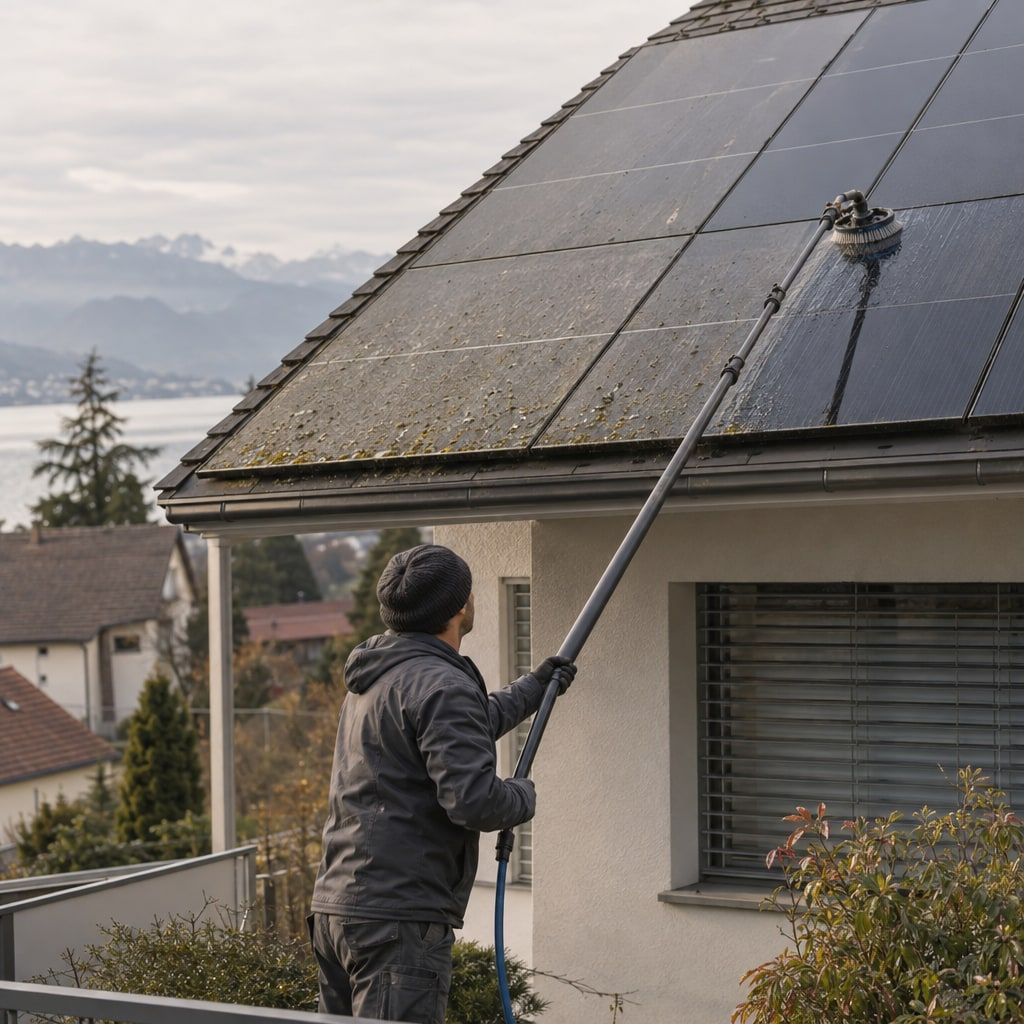
Solar panel cleaning
Cleaning photovoltaic modules with deionised water, without detergents and without scratching the glass.
A photovoltaic array is the one component on a building whose dirt can be priced in francs. It simply delivers less power, and you only notice when you hold this year’s yield curve against last year’s. That is precisely why it goes unattended for so long: it never fails, it only slowly gets worse.
The Swiss Federal Office of Energy calculates, for every municipality, how much electricity its suitable roof surfaces could produce, and it breaks the figure down by month. The pattern is the same everywhere and it is stark: July carries a multiple of the December yield. Postponing the clean until autumn means giving up the season that actually counts.
What solar panel cleaning involves
It starts with a visual check. We look at the modules, the clamps and the cable routing before any water is involved, and we report what stands out: a loose clamp, a chafed cable, a junction box working its way off the module. That is no substitute for an electrician, but it is the one close look nobody else gives the array for years at a time.
Cleaning is done with deionised water. It lifts the dirt, dries without residue and leaves no limescale rings. No detergents are used, both because the anti-reflective coating on module glass reacts badly to them and because run-off from a roof generally ends up in the ground or in the stormwater drain. The work is done at no pressure, with rotating brushes and water fed through the pole.
The lower edge of each module gets particular attention. That is where the water running off the whole surface collects, and that is where moss and lichen take hold. A band two centimetres deep sounds like nothing, but it shades a full row of cells, and one shaded row drags the whole string down with it.
Wherever height and roof pitch allow, we work from the ground with a telescopic system. Nobody has to go onto the roof, no fall protection is needed and the modules are never walked on. For higher roofs, flat-roof arrays on commercial buildings or ground-mounted arrays, we arrange a lift platform or the necessary safety measures through established partner firms.
Where solar cleaning commonly goes wrong
The most expensive mistake is the pressure washer. It drives water past the frame seal and into the junction box and can cause microcracks in the cells. None of that is visible, all of it is measurable, and the warranty is gone the moment it happens. The second mistake is detergent: what works well on window glass attacks the coating on module glass, or leaves a film that binds new dirt faster than before.
Third comes the time of day. Hosing hot module glass with cold water in full sun is thermal stress that is easily avoided. We therefore clean early in the morning, in the late afternoon, or under overcast skies.
And finally there is the question of whether a clean is needed at all. An array at thirty degrees with an even film of light dust is largely rinsed clean by rain. There, cleaning does not pay, and we say so. It looks different for modules laid below fifteen degrees, for arrays beside farmland, on main roads, under trees, or close to chimneys and ventilation outlets.
Who it is for
Solar panel cleaning is for private owners with an array on a detached house, for owner associations and managing agents with arrays on apartment buildings, and for commercial operators with large flat-roof arrays, where even a small percentage of lost yield adds up to a noticeable sum.
Farms are a category of their own. Arrays on barn and stable roofs sit in the dust of fieldwork and in the exhaust air from livestock housing, and both settle far more stubbornly than town dust.
How it works and what it costs
First we establish the basics: number of modules, roof pitch, height, access, and whether the array can be reached from the ground. For smaller arrays a few photographs and the figures from the system datasheet are usually enough. For larger properties we come and look. From that comes a quote with a fixed price, and for arrays on an annual rhythm a standing contract with a fixed spring appointment.
After the work you receive a short report with photographs from before and after, together with anything the visual check turned up. For managing agents that report goes straight to the property manager, so it lands in the property file.
Service area
We clean photovoltaic arrays in canton Schwyz from Siebnen, in the Zurich Oberland, also from Siebnen, and in the Wil SG area from our location there. Each municipality in the service area has its own page carrying the Federal Office of Energy figures for local solar potential.
In these municipalities
These places have their own page covering what applies locally, with a source for every statement.
- Solar panel cleaning Siebnen
- Solar panel cleaning Lachen
- Solar panel cleaning Wangen SZ
- Solar panel cleaning Reichenburg
- Solar panel cleaning Pfäffikon SZ
- Solar panel cleaning Freienbach
- Solar panel cleaning Hinwil
- Solar panel cleaning Wetzikon
- Solar panel cleaning Rüti
- Solar panel cleaning Dürnten
- Solar panel cleaning Bubikon
- Solar panel cleaning Gossau ZH
- Solar panel cleaning Grüningen
- Solar panel cleaning Bäretswil
- Solar panel cleaning Wald ZH
- Solar panel cleaning Pfäffikon ZH
- Solar panel cleaning Uster
- Solar panel cleaning Fehraltorf
- Solar panel cleaning Wil SG
- Solar panel cleaning Uzwil
- Solar panel cleaning Oberuzwil
- Solar panel cleaning Flawil
- Solar panel cleaning Zuzwil SG
- Solar panel cleaning Niederhelfenschwil
- Solar panel cleaning Kirchberg SG
- Solar panel cleaning Sirnach
- Solar panel cleaning Münchwilen
- Solar panel cleaning Rickenbach TG
- Solar panel cleaning Wängi
Frequently asked questions
Does cleaning a solar array actually produce measurably more power?
It depends on how dirty it is. An array with an even film of light dust loses very little, because rain washes most of it off. The difference becomes real with moss along the lower module edge, with lichen, bird droppings or a layer of pollen and farm dust, because those patches shade individual cells completely.
Why do you clean without detergents?
Module glass carries an anti-reflective coating that reacts badly to surfactants and abrasives. We therefore work with deionised water: it lifts the dirt, dries without residue and leaves no limescale rings, which would themselves act as new shaded patches on the glass.
Can a photovoltaic array be cleaned with a pressure washer?
No. High pressure can drive water past the frame seal and into the junction box, and in the worst case it causes microcracks in the cells. Either outcome voids the warranty and costs more than any cleaning. We work at no pressure, with rotating brushes and water fed through the pole.
How often should an array be cleaned?
Without any particular exposure, a check every two to three years with cleaning as required is enough. Arrays next to farmland, on main roads, under trees or laid at a shallow pitch below fifteen degrees soil far faster and need an annual rhythm instead.
What time of year is best for cleaning?
Spring, ahead of the productive half of the year. The Swiss Federal Office of Energy publishes a factsheet per municipality, and the pattern is the same everywhere: July contributes a multiple of what December does. Soiling cleared in April therefore costs far less than soiling left in place all summer.
Do you also clean arrays we cannot reach ourselves?
Yes. Up to roughly first-floor height we work from the ground with a telescopic system, without setting foot on the roof. For higher or steeper roofs we arrange a lift platform or the necessary fall protection through our partner firms.
Enquire about Solar panel cleaning
This is about your job: Solar panel cleaning. Briefly tell us what you need and we will respond personally.